
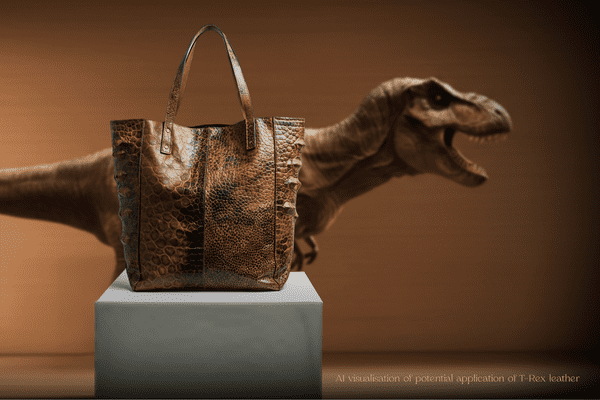
Lab-Grown Leather Ltd has reached a major technical milestone in its work to create the world’s first T. rex-inspired leather, demonstrating how advanced tissue engineering can translate cutting-edge biology into a tangible, manufacturable material for the luxury sector.
The project brings together synthetic biology, computational protein design and material science, with contributions from The Organoid Company and creative partner VML. At its core sits Lab-Grown Leather’s proprietary Advanced Tissue Engineering Platform (ATEP™), which enables complex biological inputs to be grown into structured, leather-like tissue without animals and without traditional tanning.
From Proven Platform to Prehistoric Possibility
The origins of the T. rex leather project lie not in spectacle, but in capability. While exploring next-generation materials for luxury brands, VML’s Global Chief Creative Officer, Bas Korsten, was already impressed by what Lab-Grown Leather had achieved with cultivated collagen and structured skin tissue.
It was this existing capability that prompted a more ambitious question. If Lab-Grown Leather could reliably grow real leather without animals, could the same platform be used to explore entirely new forms of leather, including those inspired by extinct species?
That question led to a collaboration with The Organoid Company, whose scientists specialise in computational biology and protein reconstruction.
Reconstructing Ancient Biology
Using fossilised amino acid fragments preserved in Tyrannosaurus rex remains, The Organoid Company computationally reconstructed a collagen sequence inspired by T. rex biology. This DNA sequence was designed, validated and then introduced by TOC into living cells, creating a stable cellular system capable of producing the target collagen.
Crucially, Lab-Grown Leather does not create or insert the DNA. Instead, it applies its ATEP™ platform to take those cells and guide them into forming structured skin tissue.
In practice, this means Lab-Grown Leather introduces TOC’s engineered cells into its tissue engineering process, where they are grown, organised and matured into leather-like material with natural structure and integrity.
Turning Biology into Leather
This step is where the project moves from scientific curiosity to material reality.
Growing collagen alone does not produce leather. Leather requires thickness, organisation, durability and consistency, all of which are dictated by how cells are grown, supported and matured over time. Lab-Grown Leather’s scaffold-free approach enables cells to self-organise into continuous sheets of tissue, avoiding the limitations of traditional scaffolds and reducing material waste.
The result is Lab-Grown 100% Real Leather, created without animals, without petrochemicals, and without the environmental cost of livestock or conventional tanning.
As Dr Che Connon, CEO of Lab-Grown Leather, explains:
“This collaboration shows that advanced biology only realises its value when it can be translated into something functional. Our role is to take complex biological inputs and turn them into real materials that industries can actually use.”
A New Class of Luxury Material
The first T. rex-inspired materials are intended for limited-edition luxury applications, where innovation, rarity and craftsmanship are valued. Early concepts include handbags and accessories, with longer-term potential in automotive interiors and other premium sectors.
What sets the material apart is not just its origin story, but its authenticity. This is not a synthetic imitation or a plant-based substitute. It is real leather, grown cell-by-cell, designed for traceability, repairability and long-term use.
The project also reinforces a wider shift in how materials are conceived.
As Marcelo Bravo, Chief Business Officer at BSF Enterprise PLC, explains, expressing dino-inspired collagen in engineered cells opens the door to entirely new material properties.
By tuning collagen composition and tissue formation at the biological level, the partners can explore materials that range from soft and flexible to remarkably robust, with levels of stiffness, durability and performance that traditional tanning processes simply cannot deliver.
The long-term ambition is the creation of paleo-inspired, animal-free leathers with tunable mechanical properties, designed for specific use cases across luxury, performance and heritage applications.
Leather is no longer limited by the animals we raise, but by the biology we can design.
Looking Ahead
This milestone demonstrates more than the feasibility of T. rex-inspired leather. It validates Lab-Grown Leather’s broader platform and its ability to support entirely new categories of material, from heritage-inspired leathers to performance-driven applications.
By combining computational biology with scalable tissue engineering, Lab-Grown Leather is laying the groundwork for a future where leather innovation is driven by design, not extraction.
For Lab-Grown Leather Ltd and its partners, this milestone signals a future where leather is no longer limited by animals or chemistry, but designed through biology itself.